Departure - On View at USC Pacific Asia Museum till 09/06/2026
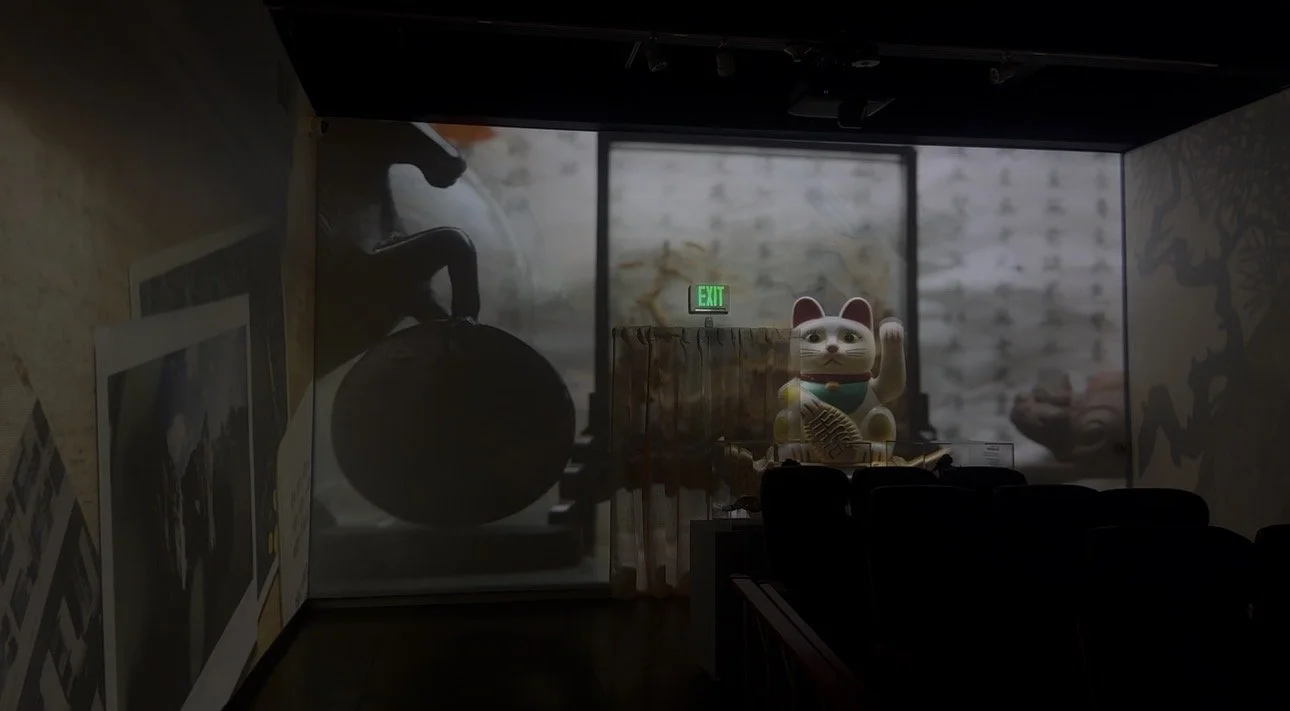
I met our curator Dave Kim when I was seeking collaborators on my documentary, “Retrograde”. When we walked through his curatorial board at his studio for this exhibition, I was immediately drawn to the narrative aspect: unlike most modern art curation, this exhibition is envisioned like a walk-through film. Coming from an art history background, I have always perceived modernism as a breakaway from the mimesis and the narrative. I was too afraid of how my love for the classics and the narrative would play against modernism, that I shifted to embrace film completely. But Dave showed me something truly unique. I appreciate the boldness and the sincerity in his curation, which brings back in the narrative and the emotive.
This four-wall projection is centered around the idea of “departure”, of “taking a flight” from where you were born and land at where you seek a new life. Meant as a transitional space in the exhibition path, the room is designed with airplane seats in the center, surrounded by wall projections. Thus when I started crafting the idea of what imageries and narrative I’d film into the piece, “space” starts playing into my way of thinking. I wanted the audience to be experiencing the space constructed by the wall projections.
The piece is divided into four sectional montage, edited against Juan Cortés Arango’s music composition that sets up the emotions between the intimate-personal and the grand-historical (in context with the exhibition’s theme of immigration stories):
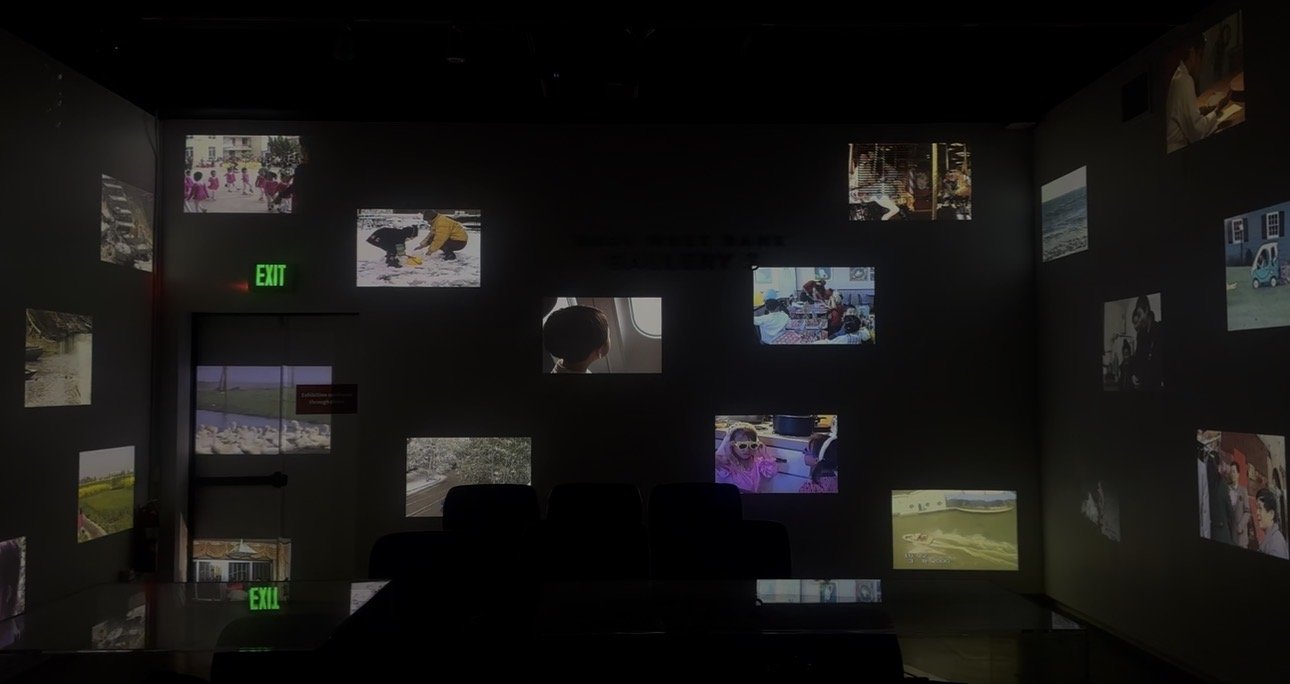
Childhood memories, where a hint of the childhood is seen in a small format on the front wall, which carries the narrative. Then I multiplied the amount of childhood memories from sourced home videos, and spread them across the four screen as if they encompass the audience completely.
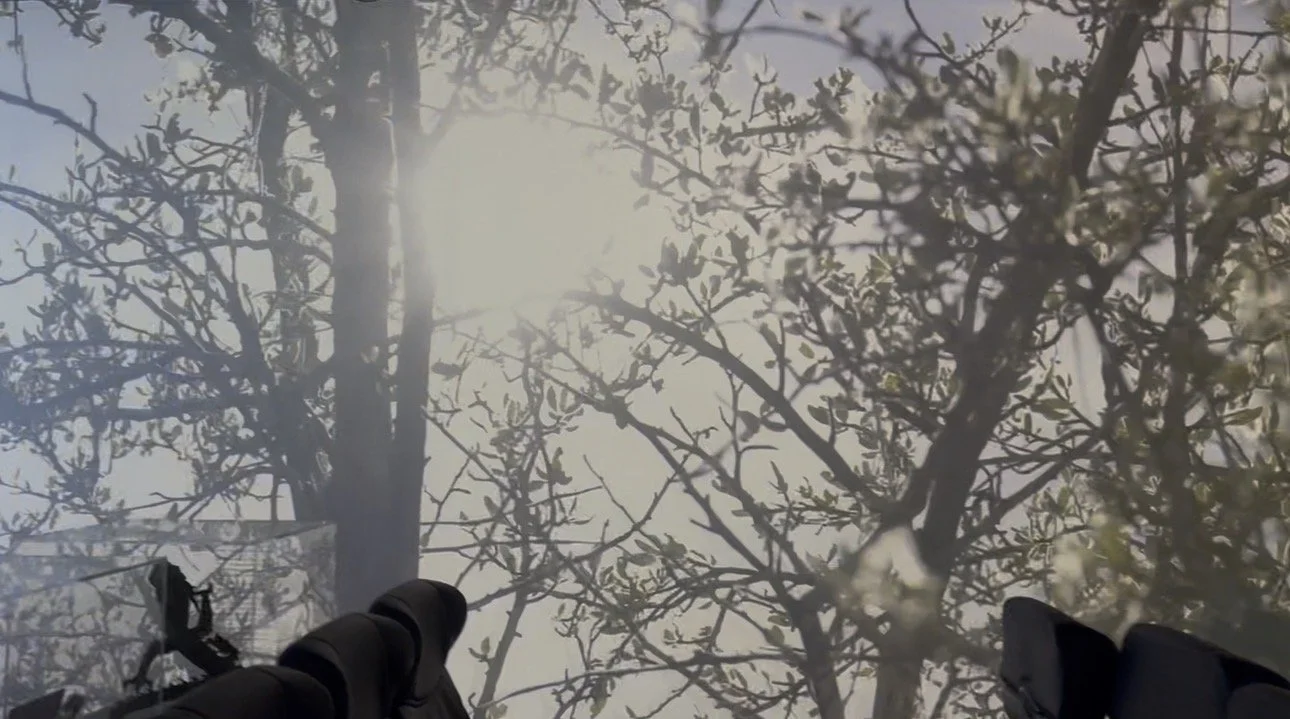
When the childhood memories fade, reasons of why we leave home are flashed across the side walls, while the front-and-back walls carry us through calmly as clouds shifts form with time. The two synchronized channels are deliberately contrasting each other in color and brightness, hoping to evoke a sense of discomfort.
Then the childhood home once take over. We hesitate, we linger, we see our family hustling around in the surrounded space helping us. When the walls start to dim down one by one, and the childhood home becomes nothing but emptiness, we know we have chosen to leave.
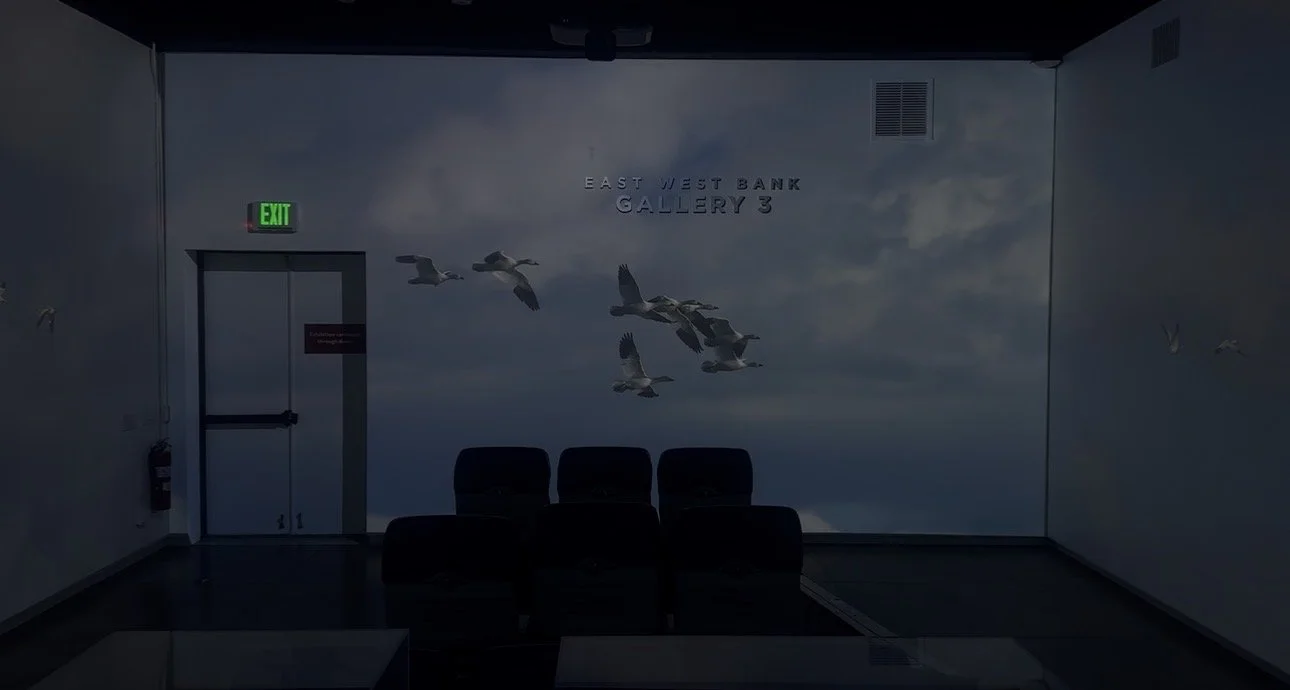
Ways of travel. From cars, to ships, to trains, and eventually, we take off with a plane. We glide through landscapes from our past, and eventually, as if a newborn child waiting for a new life, lands.
Birds/water, clouds/childhood are used as key contradicting metaphors, whereas birds/clouds signify changes and the action of leaving and water/childhood signify our core, our innocence, the essence of what made us who we are, life and landing.
Here’s also a quick shout out to my team that helped recreate the beautiful scenes of the childhood home:
Cast Josiah Lee, Jack Wang, Christine Liao, Zhan Wang
Producers Yuky Shen and Pablo Zamorano
1st Assistant Director Lisa Ranran Hu
Cinematographer Siru Wen
Gaffer Gionatan Tecle
Key Grip Keith Shattle
1st Assistant Camera Jacqueline Chan
Production Designer Taylor Liyucan Chen
Art PA Rachel Ace
Costume Designer Yuwei Hu
Hair and Makeup Artist Shy Elizabeth
PA Sophia Hernandez
Childhood Video Sourced from Ann Sun, Simon Cai, Jianjun Yuan, Xiuqin Shen, Guangyu Shen, Sarina Bolton
And thank you for my friends (and family) who helped on the rest of the project:
Mia, Diego, Ray Huang, Ben Niu, Yingzi
Shoutout to the music team:
Composer Juan Cortés Arango
Vocals Sarina Bolton
——————
When I completed the project, I realized, almost inadvertently, “nostalgia, memory, human connections” became the through-line of my narrative commitment. There is something magical about the “remembrance of the past”, that who one was build the foundation of who one will be. I can’t help but quote a favorite line from a recent read of “Brothers Karamazov” to put it against the current world climate:
“People talk to you a great deal about your education, but some good, sacred memory, preserved from childhood, is perhaps the best education. If a man carries many such memories with him into life, he is safe to the end of his days, and if one has only one good memory left in one’s heart, even that may sometime be the means of saving us.”